
HARRISBURG — A legal victory last year permitted a Pennsylvania doctor to rejoin the medical marijuana program after a yearslong fight, but it took more than eight months before the state reinstated him.
Matthew Roman, once the state's top approver of medical marijuana cards, went through a hearing and multiple rounds of written arguments as he sought to reenter the program. Last November, a deputy secretary for the Department of Health issued a final decision in his favor.
But the department, which oversees the medical marijuana program, did not reactivate his registration until after it received questions from Spotlight PA. The department blamed “an administrative error” for the delay, saying it acted quickly after receiving the newsroom’s inquiry and discovering the problem.
Spotlight PA asked about Roman’s status in the program in an Aug. 14 email, and he was reinstated four days later.
“From my side, the wait was long, and I’m glad it’s resolved,” Roman told Spotlight PA in September.
The outcome represented a victory for Roman, who was disciplined by a state medical board in 2019 related to his own cannabis use, but in 2023 had his medical license restored to unrestricted status. His subsequent attempt to return to the medical marijuana program raised questions about the Department of Health’s oversight powers, the amount of discretion it holds, and what type of barriers physicians with unrestricted state medical licenses should face if they want to approve patients for medical marijuana cards. The department’s final decision could offer clarity for other doctors who have been removed from Pennsylvania’s medical cannabis program due to disciplinary action.
In response to a 2024 Spotlight PA investigation that featured Roman and other physicians, some lawmakers called for the Department of Health to have greater power over medical marijuana doctors. Their proposal would expressly allow the agency to impose certain conditions on physicians who want to approve patients for cannabis, including a term of probation and a limit on the number of certifications they could issue in a set time period.
For Roman, the case was “about due process” after years of treatment and monitoring, and obtaining an unrestricted medical license. He told Spotlight PA in September that he had not issued any medical cannabis certifications since his return to the program a month earlier and did not intend to.
“I didn’t want a permanent bar after I’d done the work to get well and practice medicine again,” said Roman, who works as a primary care physician. “Being eligible is not the same as choosing that as my clinical focus.”
Under the program, patients need a certification from a physician to obtain a medical marijuana card and buy cannabis from dispensaries. Physicians in turn need permission from the Department of Health to be authorized to approve patients. The program had about 1,900 approved practitioners and about 439,000 active patient certifications as of earlier this year.
Pennsylvania’s medical marijuana law requires the Department of Health, when deciding whether to admit practitioners into the program, to review whether they have a valid medical license and “whether the physician has been subject to discipline.” But the law does not specifically address how the department should assess past discipline.
In Spotlight PA’s prior investigations, the news organization found that from the start of 2017 to at least mid-May of 2024, Roman was the only denied doctor whose appeal reached a hearing.
Views varied regarding how regulators should treat doctors with past discipline, Spotlight PA previously reported. One advocate for cannabis legalization told Spotlight PA it made sense to apply additional scrutiny to disciplined doctors, while another said certifying for cannabis should not be treated more strictly than performing surgery or prescribing opioids.
In Roman’s case, in a final determination and order, a deputy secretary for the Department of Health maintained that the agency has discretion when doctors have been removed due to discipline, but said “the record in this matter does not support a rational basis for the denial of Dr. Roman’s reapplication.” The order said his reapplication would be granted once “any remaining administrative requirements and payment of any remaining fees” were completed.
A long process
Roman’s case dates back several years.
He was a well-known medical marijuana doctor in Pennsylvania. In 2018, the year dispensaries began selling cannabis in the state, he was the only doctor to issue more than 3,000 medical marijuana certifications, records show. But underneath all the attention, Roman had a drug problem, he later said.
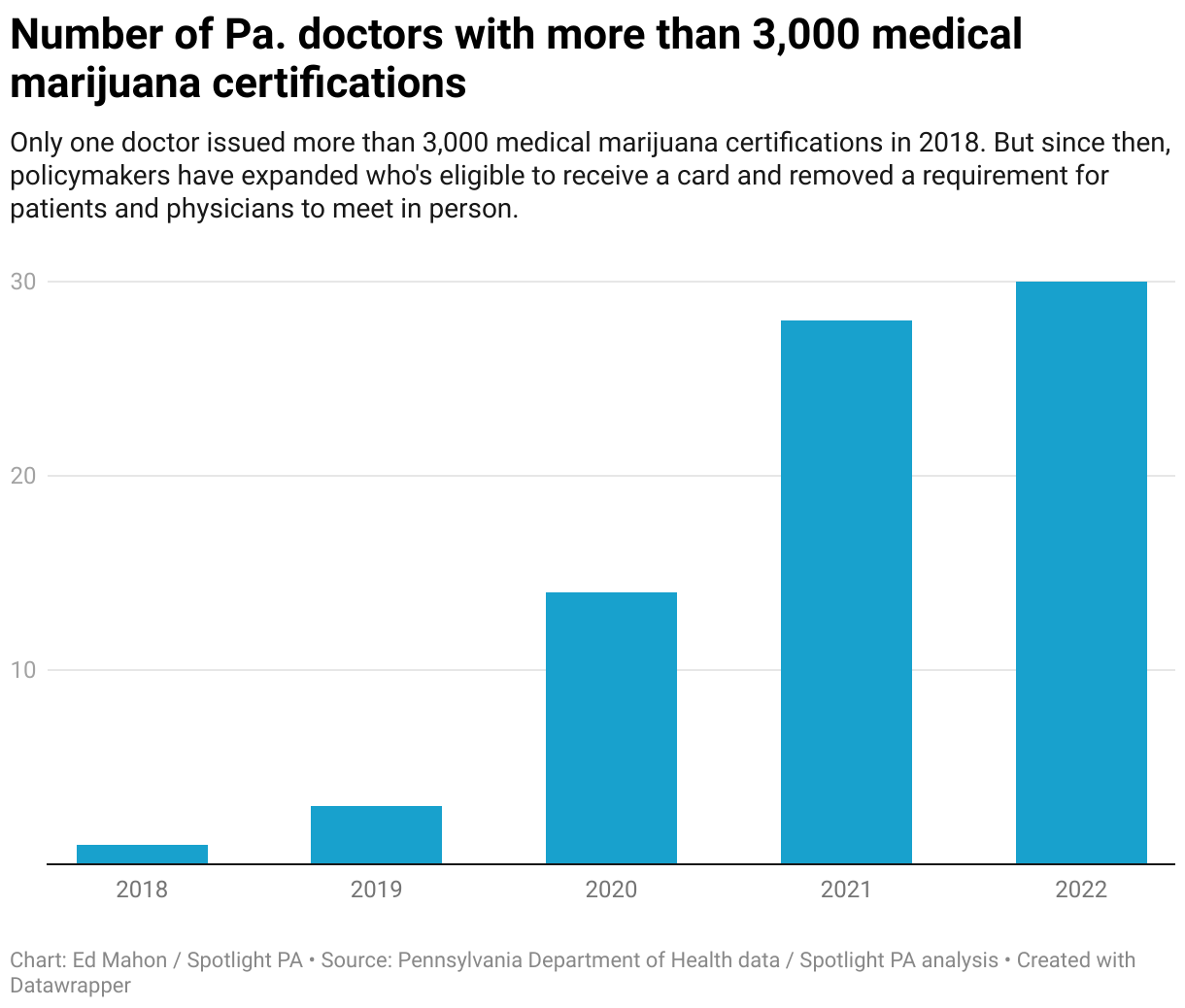
In 2019, a state medical board disciplined him, with a consent agreement saying he displayed a problematic pattern of cannabis use “leading to clinically significant impairment” and met criteria for cannabis use disorder. Additional disciplinary action followed, including probation and suspension of his Pennsylvania medical license. He also lost his ability to certify patients for the state’s medical marijuana program.
“When they took my license away, I had nothing left,” Roman told Spotlight PA. “I messed up with my family. … I was alone.”
But he went to rehab and participated in therapy, and in 2023, the State Board of Medicine reinstated his medical license to an unrestricted, nonprobationary status.
Still, the Bureau of Medical Marijuana rejected his application to return to the program.
He appealed, and in April 2024, a hearing examiner recommended he be allowed to return. The examiner cited the State Board of Medicine’s order reinstating his medical license as evidence that the reasons for the discipline had been resolved.
But the Bureau of Medical Marijuana objected. An attorney for the bureau argued that under the hearing examiner’s approach, the bureau would be required to approve every application from a physician who “had a valid, unexpired, unrevoked, unsuspended Pennsylvania license to practice medicine, regardless of any prior discipline by the State Board of Medicine.”
The attorney for the bureau also described limits on the agency’s power, writing that the state’s medical marijuana law and regulations don’t give the bureau “the same investigation resources or authority to require extra requirements to prove compliance” that other agencies, including a licensing board, hold.
During the process, Roman described how his views on marijuana have changed, saying that “cannabis should be a last resort.” The bureau raised concerns that he would deny certifications to patients who have a qualifying medical condition — which could lead to extra costs and delays in access to medication for patients.
In Deputy Secretary Cindy Findley’s November 2025 final determination, she said there was “no evidence that Dr. Roman’s opinion that medical marijuana should be used as a last resort treatment is beyond an accepted standard of care or not a proper ‘professional opinion.’”
Some doctors in the program issue zero or a relatively small number of certifications, Spotlight PA found. In 2022, health department data show more than 300 doctors each issued 1 to 10 certifications. Several hundred other doctors included in records provided to Spotlight PA had no certifications listed that year.
William Stauffer, a Pennsylvania recovery advocate, welcomed the department’s decision in favor of Roman, saying safeguards already exist for doctors who previously experienced impairment. He knows anesthesiologists and other types of physicians who are in recovery and prescribe medications — and can so do as professionals without relapsing.
“I don't use medical cannabis, but I would actually, in some ways, feel more confident about a doctor in recovery who has some personal experience with the negative side effects of what can happen with these drugs,” Stauffer, executive director of the Pennsylvania Recovery Organizations Alliance, told Spotlight PA. “I don't think that that's a downside.”
After that victory, Roman’s return still took months.
Officials with the Pennsylvania Department of Health offered different explanations for the delay.
In August, after Spotlight PA’s initial inquiry, agency spokesperson Eli Steiker-Ginzberg said Roman “recently completed the remaining requirements” but did not provide details on what those requirements were or when specifically they were completed.
After more questions and an open records request from Spotlight PA, another agency spokesperson described “procedural steps” that the Department of Health needed to complete before Roman’s reinstatement and said that at “no time did Dr. Roman contact the Department to express any concerns.”
Spotlight PA had asked the health department whether the news organization’s Aug. 14 inquiry prompted or influenced any review of Roman’s status. The health department spokesperson’s early October statement said: “As we routinely do when an inquiry names a specific doctor in our system, their account is reviewed. In this case, a simple mis-toggling of a button delayed the procedural final update to Dr. Roman’s account. It was fixed and he was reinstated August 18, 2026. No patient services were disrupted at any point.”
The agency defended how it handled the case.
“Dr. Roman’s removal and subsequent readmittance to the Medical Marijuana program shows the program working as designed to ensure both patient and public safety,” Steiker-Ginzberg said in late October. “The Department will not hesitate to hold doctors and certifiers accountable when their actions put others at risk.”
As Roman’s case unfolded, efforts to increase medical marijuana doctor oversight gained momentum — then stalled.
In March of last year, a bill with new oversight measures inspired by Spotlight PA's reporting passed out of the state House 194-8. The legislation had not come up for any votes in the Republican-controlled Senate as of early November. In addition to giving the Department of Health the ability to impose a term of probation on medical marijuana doctors and set certification limits, the bill would also allow regulators to require supervision by another practitioner and additional reporting to the department.
Last year, a health department spokesperson told Spotlight PA the agency was “closely monitoring” the legislation. Now, the department has gone further. In late October, spokesperson Steiker-Ginzberg said the agency “supports legislative efforts to clarify the Department's oversight of practitioners and laboratories participating in the Medical Marijuana Program as a bipartisan group of House lawmakers have tried to do in House Bill 33.”
Roman, for his part, told Spotlight PA he supports the effort to increase physician oversight. He said the proposed measures would stop doctors from approving cannabis “for recreational use under the guise of it being medical.”
He now has nuanced views on cannabis, and believes recreational use should be legalized “because it’s a free country.” But he’s also focused on a recovery program he created, based on Stoic philosophy, to help “people get and stay sober, including getting off marijuana when that’s their struggle.”
“I focus on being a virtuous person and working on my character,” he said, “and then secondarily, from that, I don’t have … a desire to use or ever go back to pot, or drinking, or any other drugs.”